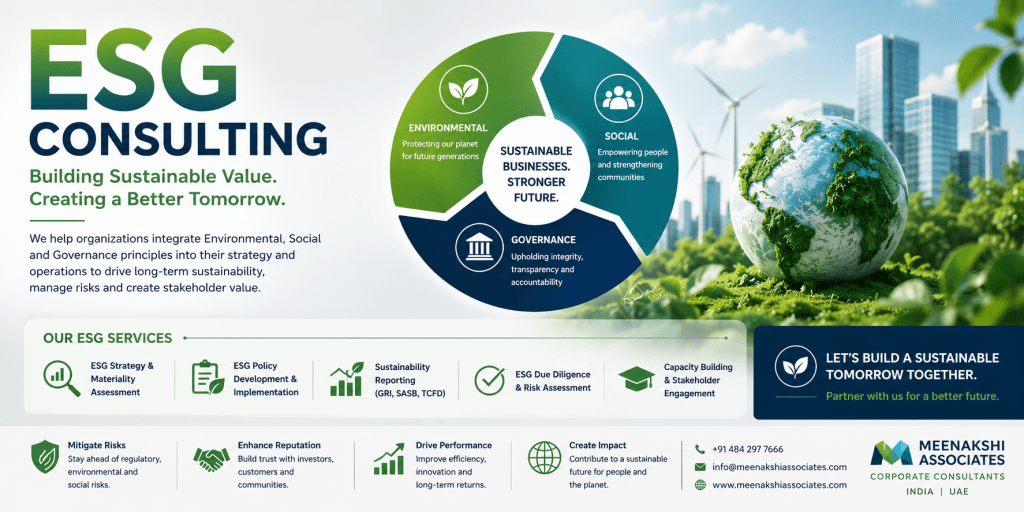
ESG – The Cornerstone of Business Sustainability
In the modern business landscape, success is no longer measured solely by profitability. Investors, regulators, customers, employees, and society increasingly expect businesses to operate responsibly, ethically, and sustainably. This shift has made Environmental, Social, and Governance (ESG) principles the cornerstone of long-term business sustainability.
ESG is not merely a compliance framework or a corporate trend—it is a strategic approach that enables organisations to create lasting value while managing risks, strengthening stakeholder confidence, and contributing positively to society and the environment.
Understanding ESG
Environmental (E)
The Environmental pillar focuses on how a company manages its impact on the natural environment. Businesses are expected to adopt sustainable practices that reduce their environmental footprint and promote responsible use of natural resources.
Key considerations include:
- Climate change mitigation and adaptation
- Carbon emissions reduction
- Energy efficiency and renewable energy adoption
- Waste management and recycling
- Water conservation
- Pollution prevention
- Sustainable sourcing and resource management
Organisations that embrace environmental responsibility not only contribute to global sustainability goals but also improve operational efficiency and reduce long-term costs.
Social (S)
The Social component examines how an organisation manages its relationships with employees, customers, suppliers, communities, and other stakeholders.
Important aspects include:
- Employee welfare and workplace safety
- Diversity, equity, and inclusion
- Human rights and labour practices
- Customer satisfaction and data privacy
- Community engagement and social responsibility
- Employee development and wellbeing
- Ethical supply chain management
Companies with strong social practices tend to enjoy higher employee engagement, stronger customer loyalty, and improved brand reputation.
Governance (G)
Governance represents the framework through which companies are directed and controlled. Strong governance promotes accountability, transparency, ethical decision-making, and effective oversight.
Governance considerations include:
- Effective Board composition and independence
- Corporate ethics and integrity
- Regulatory compliance
- Risk management
- Internal controls and audit mechanisms
- Shareholder rights
- Executive remuneration
- Transparent disclosures
- Anti-corruption and whistleblower mechanisms
Good governance builds investor confidence and strengthens organisational resilience.
Why ESG Matters
Businesses across the world are recognising that ESG performance directly influences long-term success. Organisations with effective ESG practices are better positioned to:
- Enhance corporate reputation and stakeholder trust
- Attract investors seeking responsible businesses
- Improve access to capital and financing
- Strengthen regulatory compliance
- Reduce operational and reputational risks
- Increase customer confidence and brand loyalty
- Improve employee attraction and retention
- Drive innovation and operational efficiency
- Build resilient and future-ready business models
Rather than viewing ESG as a cost, forward-looking companies consider it a strategic investment that supports sustainable growth and competitive advantage.
ESG and Corporate Governance
Corporate governance forms the foundation of effective ESG implementation. A proactive Board of Directors plays a crucial role in embedding ESG into the organisation’s strategy, overseeing sustainability initiatives, monitoring ESG risks, and ensuring transparent reporting.
Independent Directors, Board Committees, and senior management together establish policies and systems that integrate ESG considerations into business decision-making, enabling companies to meet stakeholder expectations while creating long-term value.
ESG: A Business Imperative
Global markets are increasingly rewarding companies that demonstrate responsible business practices. Investors, financial institutions, customers, and regulators now consider ESG performance when evaluating businesses.
Companies that proactively integrate ESG principles are more resilient, better prepared to manage emerging risks, and more likely to achieve sustainable profitability over the long term.
ESG is no longer an optional initiative—it is a business imperative that shapes corporate reputation, investor confidence, operational excellence, and sustainable value creation.
How Meenakshi Associates Can Help
Meenakshi Associates, Corporate Consultants, assists businesses in embedding ESG principles into their governance and strategic framework. Our advisory services include:
- ESG governance framework development
- Board advisory on ESG responsibilities
- Corporate governance reviews
- Board Committee structuring
- Sustainability governance and policy support
- Risk management and compliance advisory
- Independent Director advisory
- Regulatory compliance and governance best practices
- Corporate restructuring and governance enhancement
With offices in India and Dubai, UAE, we help organisations build governance systems that align with ESG principles, enhance stakeholder confidence, and support sustainable business growth.
Sustainable businesses are not built by chance—they are built through responsible governance, ethical leadership, and a long-term commitment to Environmental, Social, and Governance (ESG) principles.
 Meenakshi Associates
Leave a comment